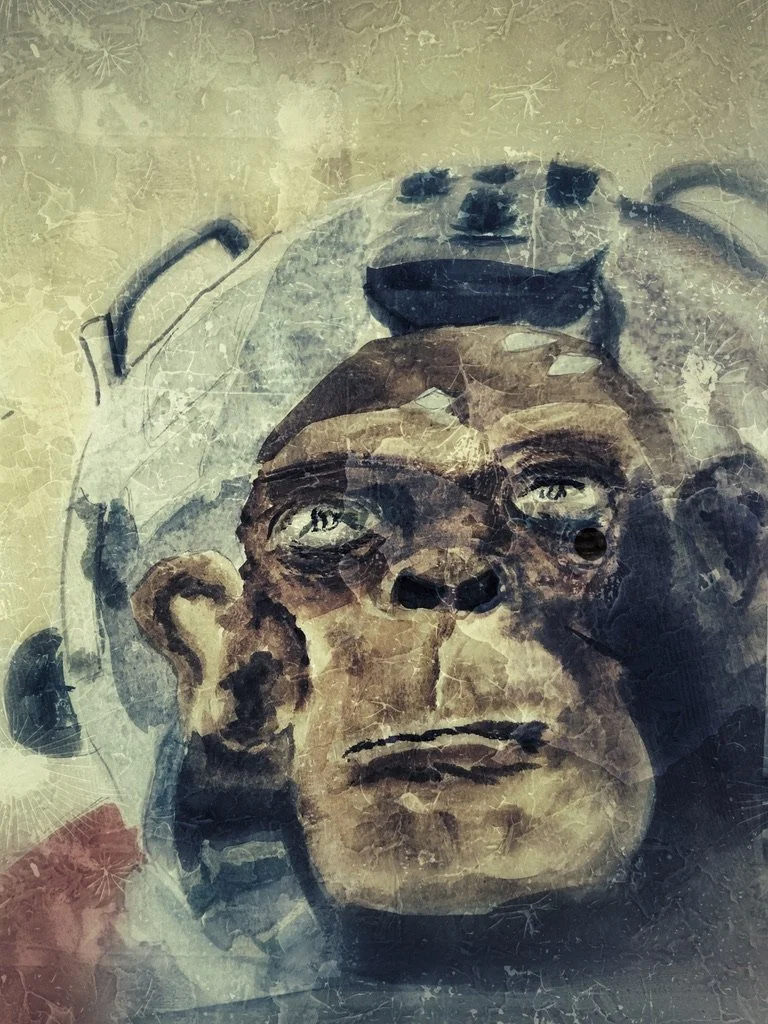
The Space Monkey painting was from an adult art class session at Sharon Art Studio, Golden Gate Park, San Francisco. This painting was my first moment of pure joy, where I actually created something I could be proud of. I took the painting to be framed and was asked, “Who painted this?’ I was thrilled to tell them it was me! Symbolically, it is also representative of my launchpad for exploring my creativity.
On January 31, 1961, after several hours of waiting on the launch pad at Cape Canaveral, FL, 3 ½ year old Ham was propelled into space, strapped into a container called a “couch.”
Ham’s flight lasted approximately 16 ½ minutes. He traveled at approximately 5800 mph to a height of 157 miles above Earth. He experienced about 6 ½ minutes of weightlessness. Incredibly, despite the intense speed, g-forces, and weightlessness, Ham performed his tasks correctly. After the flight, Ham’s capsule splashed down 130 miles from its target and began taking on water. It took several hours for a recovery ship to reach Ham, but miraculously, he was alive and relatively calm considering his ordeal. When he was finally released from the “couch,” however, his face bore an enormous grin. Although interpreted as a happy smile by many people, Ham’s expression was one of extreme fear and anxiety. That fear was demonstrated again sometime later through an act of defiance. Photographers wanted another shot of Ham in his “couch.” Ham refused to go back into it, and several adult men were unable to force him.
Unlike the rest of the space chimps, Ham was spared decades of biomedical research, but he did have a lonely existence for many years. He was transferred to the National Zoo in 1963, where he lived alone for 17 years, before finally being sent to the North Carolina Zoo, where he could live with other chimps. He died 22 years after his historic flight into space, on January - Source Wikipedia
The Space Monkey painting was from an adult art class session at Sharon Art Studio, Golden Gate Park, San Francisco. This painting was my first moment of pure joy, where I actually created something I could be proud of. I took the painting to be framed and was asked, “Who painted this?’ I was thrilled to tell them it was me! Symbolically, it is also representative of my launchpad for exploring my creativity.
On January 31, 1961, after several hours of waiting on the launch pad at Cape Canaveral, FL, 3 ½ year old Ham was propelled into space, strapped into a container called a “couch.”
Ham’s flight lasted approximately 16 ½ minutes. He traveled at approximately 5800 mph to a height of 157 miles above Earth. He experienced about 6 ½ minutes of weightlessness. Incredibly, despite the intense speed, g-forces, and weightlessness, Ham performed his tasks correctly. After the flight, Ham’s capsule splashed down 130 miles from its target and began taking on water. It took several hours for a recovery ship to reach Ham, but miraculously, he was alive and relatively calm considering his ordeal. When he was finally released from the “couch,” however, his face bore an enormous grin. Although interpreted as a happy smile by many people, Ham’s expression was one of extreme fear and anxiety. That fear was demonstrated again sometime later through an act of defiance. Photographers wanted another shot of Ham in his “couch.” Ham refused to go back into it, and several adult men were unable to force him.
Unlike the rest of the space chimps, Ham was spared decades of biomedical research, but he did have a lonely existence for many years. He was transferred to the National Zoo in 1963, where he lived alone for 17 years, before finally being sent to the North Carolina Zoo, where he could live with other chimps. He died 22 years after his historic flight into space, on January - Source Wikipedia